Galactic Events Timeline
The year is 2401 / Stardate 78789.0
Decades have passed since the Dominion War brought the Alpha and Beta Quadrants to the brink of ruin. The great powers survived, but none emerged unchanged. Borders were rebuilt, alliances were renegotiated and entire generations entered Starfleet having known little except crisis, reconstruction and uncertainty.
For a time, the Federation believed the worst had passed.
Then Romulus was destroyed.
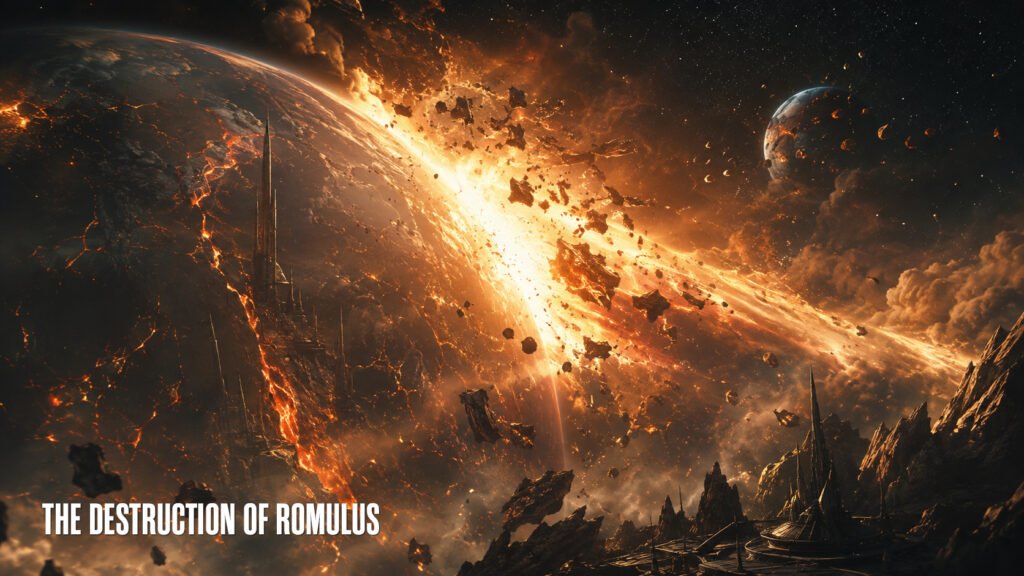
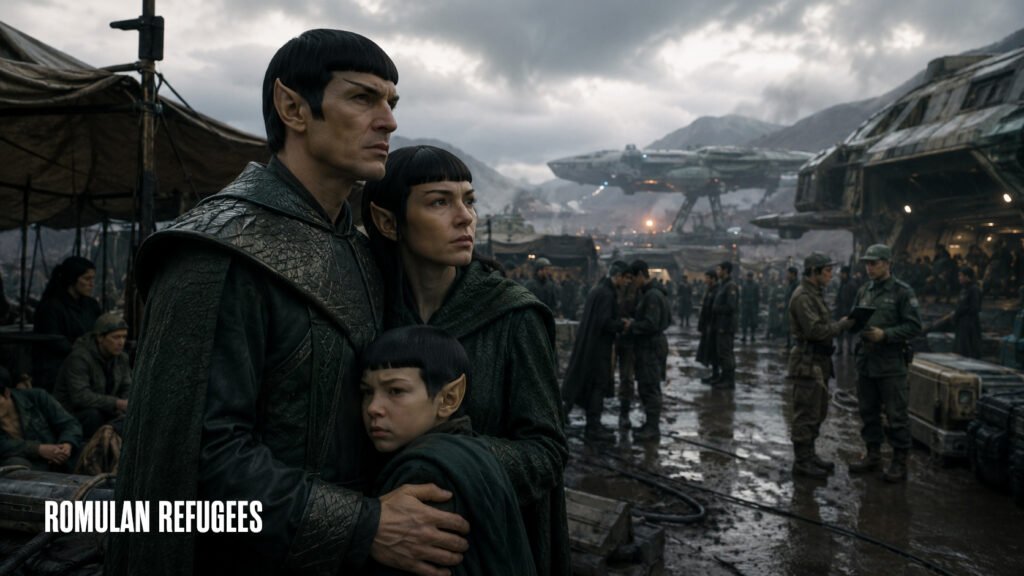
The supernova shattered the Romulan Star Empire and scattered its people across dozens of worlds. Refugees fled in every direction, ancient political structures collapsed and long-established colonies found themselves cut off from the authority that had governed them for centuries.
What remained of Romulan space fractured into competing powers.
The Romulan Free State controls a number of strategically important systems and maintains many of the traditions of the old Empire, but it speaks for only part of the Romulan people. Independent colonies, military enclaves, refugee communities and former imperial territories now operate according to their own interests. Some seek closer relations with the Federation. Others cling to old suspicions. Still others have fallen under the influence of intelligence networks, private armies or political factions whose ultimate aims remain unknown.
There is no longer one Romulan policy, one Romulan border or one Romulan future.
Every settlement must be approached on its own terms. Every alliance carries its own risks.
Every Romulan vessel encountered in deep space may represent a government, a colony, a warlord, a relief mission—or no recognised authority at all.
The destruction of Romulus also reshaped the Federation.
The failed evacuation effort, the attack on Mars and the subsequent ban on synthetic life marked one of the darkest periods in recent Starfleet history. The shipyards of Utopia Planitia burned. Thousands died. Starfleet withdrew from responsibilities it had promised to uphold, and many within the Federation began to question whether the organisation still possessed the courage to live by its own ideals.
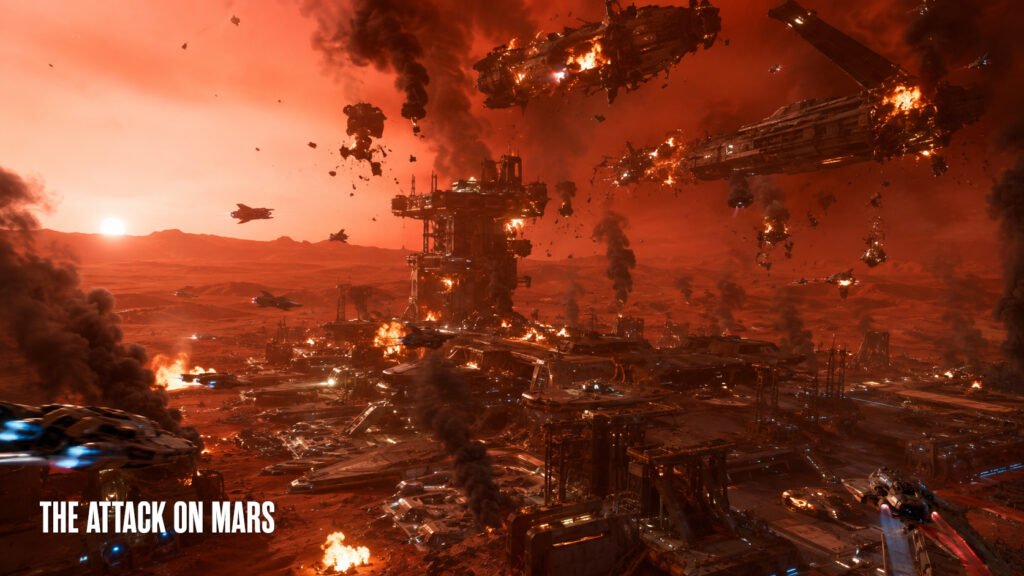
Mars has not forgotten. Neither has Starfleet.
Although the synthetic ban was eventually lifted, the political and emotional scars remain. Some officers view artificial life with renewed curiosity and respect. Others remain deeply uncomfortable with autonomous systems, networked decision-making and technologies capable of acting beyond direct organic control.
Those tensions became even more significant after Frontier Day.
In 2401, Starfleet’s greatest celebration became a catastrophe.
A fleet-wide systems integration programme allowed almost every active vessel to be linked together under central control. The same network that had been intended to demonstrate unity and technological progress was turned against Starfleet. Younger officers were transformed into Borg drones. Federation ships opened fire on one another. Earth stood on the edge of destruction.
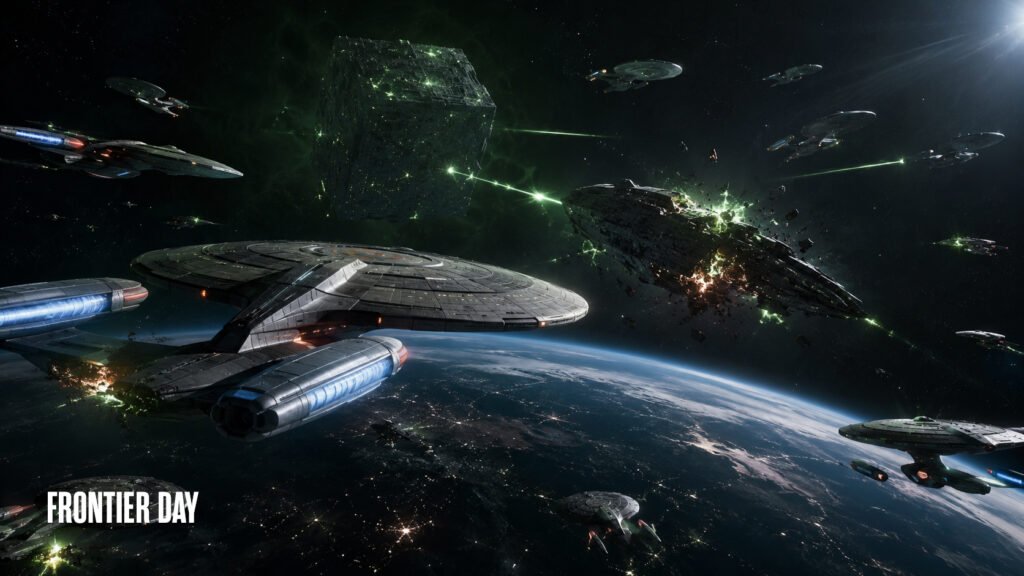
The attack was defeated, but the psychological damage cannot be repaired as easily as a starship hull.
Almost every serving officer knows someone who was assimilated, wounded or killed. Captains who once embraced automation now demand independent controls. Engineers have restored physical isolation systems that had been considered obsolete. Security officers question every unexplained signal and every software update. Some younger officers struggle with guilt over actions committed while under Borg control, while older personnel carry the memory of watching their own crews become the enemy.
Starfleet survived Frontier Day. Confidence did not survive so easily.
The Borg Collective itself no longer represents the unified galactic power it once did. Its influence has fractured, its great networks have been damaged and many of its former drones now exist beyond the direction of a single controlling intelligence.
Yet the end of the Collective has not ended the danger.
Abandoned cubes drift in remote systems. Damaged transwarp conduits still open without warning.
Borg technology continues to attract scavengers, governments and private researchers who believe they can control what destroyed so many others.
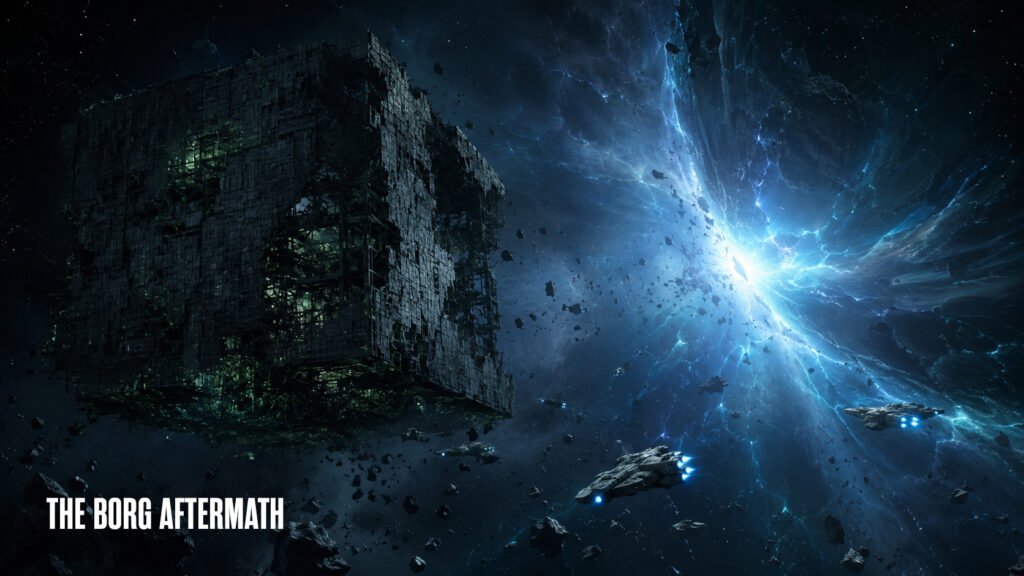
Former drones search for identities beyond the Collective, while isolated groups continue to follow commands issued by voices that may no longer exist.
The galaxy no longer fears an unstoppable Borg invasion.
It fears what the Borg left behind.
The Klingon Empire remains comparatively stable, but peace has created challenges of its own.
A generation of Klingons has grown to adulthood without experiencing a war on the scale of the Dominion conflict. Some see this as proof that the Empire has entered a more honourable and prosperous age. Others believe prolonged peace has weakened the Great Houses and deprived young warriors of the opportunity to earn glory.
Old rivalries have begun to surface once again.
Some Houses press for stronger action against Romulan factions occupying disputed territory. Others call for renewed expansion into poorly defended regions. A growing movement within the Empire argues that honour need not be found through conquest alone, and that exploration, defence and service to allies may prove just as worthy as battle.
The Empire remains united, but not entirely at ease with itself.
The Cardassian Union continues its long recovery from the Dominion War.
Cities have been rebuilt. Institutions have returned. Trade has resumed across former borders. Yet reconstruction has not erased the memory of occupation, collaboration and genocide.
Cardassia remains a civilisation forced to live beside the consequences of its own history.
Some Cardassians demand a complete break with the militarism of the past. Others believe Cardassia has become weak, humiliated and too dependent on foreign assistance. Former military families, civilian reformers, religious movements and regional governments compete to define what the Union will become.
Relations with Bajor and the Federation have improved, but trust remains fragile.
A Cardassian vessel entering Federation territory may be welcomed as a partner, watched as a potential threat or treated as a reminder of wounds that have never fully healed.
The Bajoran people have entered a new era of confidence and uncertainty.
Decades of independence, reconstruction and close cooperation with the Federation have transformed Bajor from an occupied world into one of the most politically and spiritually influential societies in the region. Yet the balance between faith, national identity and Federation partnership remains a source of debate.
Some Bajorans see their future as inseparable from the Federation.
Others fear that membership would weaken the traditions preserved through occupation and resistance.
Religious factions continue to argue over the interpretation of prophecy, the role of the Emissary and Bajor’s place in events that may extend far beyond the planet itself.
The wormhole remains open. The Gamma Quadrant remains accessible. And the Dominion still exists.
Relations between the Dominion and the Alpha Quadrant are no longer defined by open war, but neither are they founded on trust. The Founders have withdrawn from the expansionist ambitions that once threatened the Federation, yet the full extent of their influence remains unknown.
Some worlds in the Gamma Quadrant remember the Dominion as an oppressor.
Others remember it as the only power that brought order.
Starfleet missions beyond the wormhole therefore carry a different kind of danger. The next Dominion encounter may involve diplomacy, trade, humanitarian relief, covert influence or the consequences of conflicts abandoned when the war ended.
The Gamma Quadrant is not enemy territory. It is uncertain territory.
The Ferengi Alliance has prospered through every stage of galactic recovery.
Where governments needed resources, the Ferengi supplied them. Where refugees needed transport, Ferengi captains found space. Where infrastructure had collapsed, Ferengi investors offered credit—usually at a considerable profit.
The reforms begun under Grand Nagus Rom have changed the Alliance, but they have not eliminated the Ferengi instinct for opportunity.
Some Ferengi businesses now operate openly within Federation law and provide vital services across dozens of sectors. Others exploit unstable borders, abandoned colonies and communities desperate for supplies.
To many worlds, the Ferengi are indispensable partners.
To others, they are profiteers who arrive shortly before a crisis becomes expensive.
The Breen Confederacy remains one of the quadrant’s most unpredictable powers.
Breen vessels continue to appear in disputed systems, mercenary fleets and heavily armed trading convoys. Their political structure remains opaque, their long-term goals are rarely stated and their alliances appear to shift according to interests that outsiders do not fully understand.
Reports of Breen weapons and technology entering the hands of raiders have increased. So have rumours that the Confederacy is preparing for a larger movement beyond its established borders.
Starfleet Intelligence has found no evidence of an imminent invasion. That has not prevented regional commanders from strengthening patrols.
Other powers are rising beyond the familiar political map.
The Fenris Rangers operate where governments cannot or will not intervene. Former neutral systems have begun forming defensive coalitions. Independent colonies increasingly resist instruction from distant capitals. Private security fleets protect trade routes once considered safe enough for civilian travel.
Even within the Federation, old assumptions are being questioned.
The Federation is not collapsing. It remains one of the largest, most technologically advanced and politically influential organisations in known space. But its member worlds no longer agree automatically on what its future should be.
Some believe the Federation has expanded too quickly and assumed responsibility for regions it cannot properly protect. Others argue that fear has made it too cautious.
Some demand stronger borders, greater military readiness and tighter control over advanced technology.
Others insist that every retreat from exploration represents a betrayal of the principles on which the Federation was founded.
These are not yet fractures. They are questions. But they are questions Starfleet can no longer avoid.
For almost thirty years, Starfleet has reacted to disasters.
The Dominion War. The destruction of Romulus. The attack on Mars. The synthetic ban. Repeated Borg incursions. Frontier Day.
Each crisis demanded ships, officers and resources. Exploration vessels were redirected to patrol routes, humanitarian operations and strategic deployments. Scientific missions were delayed. Survey programmes were reduced. Regions once marked for long-term study were left to automated probes and distant listening posts.
Starfleet became exceptionally skilled at surviving emergencies.
It became less certain how to pursue the future.
That is now beginning to change.
With no major war currently dominating Federation policy, Starfleet has begun returning ships to long-range scientific and exploratory assignments. New outposts are being commissioned. Old probe routes are being revisited. Subspace observatories are scanning regions that have received little attention since before the Dominion War.
The change is not a return to the unquestioned confidence of the 2360s.
Starfleet cannot forget what it has learned.
Explorers now travel with stronger defensive systems, greater autonomy and fewer assumptions about what awaits them. Captains are expected to act as scientists, diplomats, strategists and representatives of Federation values—often while weeks away from reinforcement.
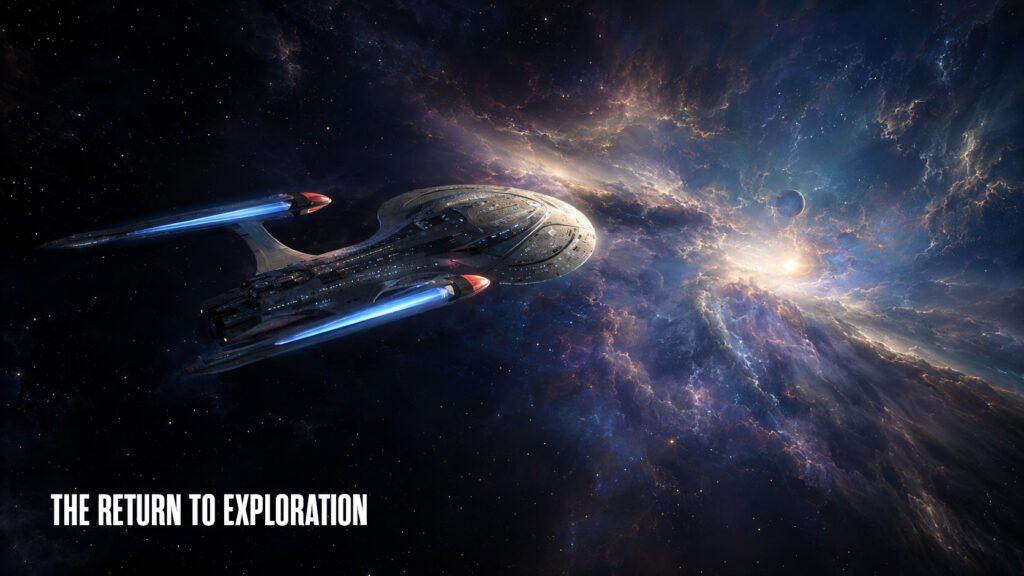
Among the vessels assigned to this renewed mission is the USS Navigator, NCC-98401.
An Odyssey-class command explorer, the Navigator is one of the largest and most capable deep-space vessels in Starfleet service.
She was not built because Starfleet expects another war. She was built because Starfleet expects distance.
Her laboratories can support years of scientific work. Her diplomatic suites can host delegations from worlds that have never encountered the Federation. Her medical facilities can respond to planetary disasters. Her auxiliary vessels can operate independently across entire systems. Her command facilities allow her to coordinate exploration, rescue and emergency operations far beyond established starbases.
The Navigator represents a statement of intent.
Starfleet has spent decades looking inward, defending what it already knows.
Now it is looking outward again. Not towards empty space, but towards regions layered with forgotten histories.
Ancient star charts identify worlds that have not been visited for centuries. Long-range probes have stopped transmitting without explanation. Civilisations encountered by earlier generations have vanished, changed or withdrawn behind borders that did not previously exist.
There are relay stations whose signals have suddenly returned after decades of silence.
There are sectors where modern maps do not match archived sensor records.
There are worlds listed in Starfleet databases that no longer appear to be there.
The USS Navigator is not simply travelling where nobody has gone before.
She is going where nobody has gone back to.
Beyond the established frontiers lie civilisations untouched by Federation diplomacy, phenomena beyond current scientific understanding and powers that have watched the Alpha and Beta Quadrants from a distance.
Some may welcome Starfleet. Some may fear it. Some may remember encounters that the Federation itself has forgotten.
The mission of the Navigator is to enter those regions, listen before judging and discover what lies beyond the edge of the known map.
The dangers will not always announce themselves as enemies.
A diplomatic misunderstanding may be more dangerous than a hostile fleet.
An ancient piece of technology may reshape an entire civilisation.
A distress signal may have been travelling through space for a hundred years.
A world requesting Federation membership may be hiding the very truth Starfleet was sent to uncover.
Every new discovery will force the crew to decide not only what they have found, but what Starfleet should do about it.
The age of certainty is over.
The age of exploration has returned.